
- Published on
Capitol vs. Capital: What Is the Difference?
- Authors

- Name
- Tony
- @shyeditor
What Is the Difference Between Capitol and Capital?
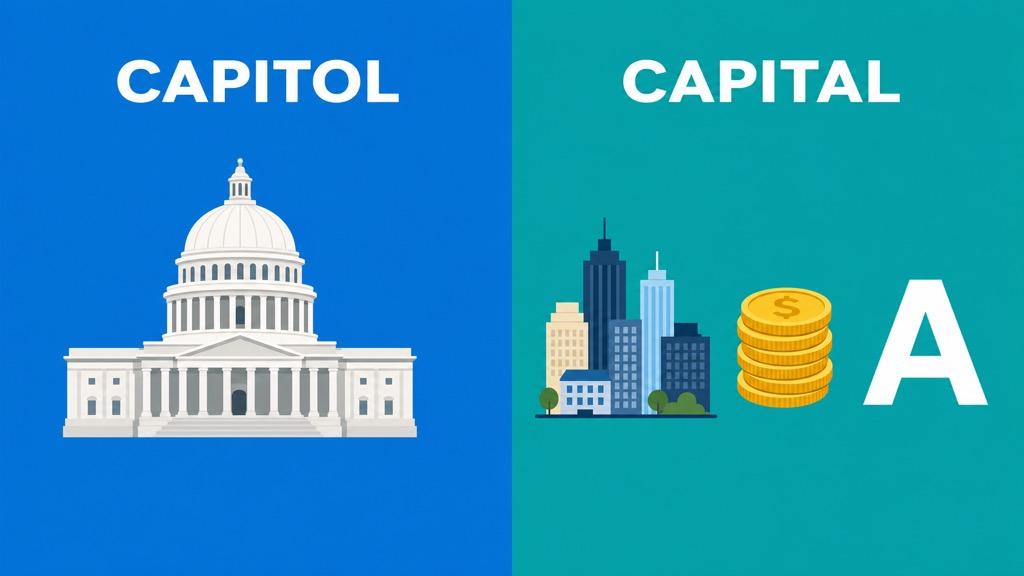
"Capitol" refers to the specific building where a legislature meets. "Capital" covers everything else: a capital city, money or assets, uppercase letters, and the sense of "most important." The two words sound exactly the same, but "capitol" has just one narrow meaning while "capital" carries several.
- Capitol: "Protesters gathered on the steps of the Capitol." (The legislative building.)
- Capital: "Paris is the capital of France." (The chief city.)
- Capital: "The startup raised capital from investors." (Money.)
- Capital: "Begin each sentence with a capital letter." (Uppercase.)
The simple rule: "capitol" is a building, and almost everything else is "capital."
Why Do People Confuse Capitol and Capital?
The words are perfect homophones, pronounced identically, and differ by a single letter. Because "capital" has so many meanings, writers often default to it everywhere or, knowing one word means a building, second-guess which spelling to use. The fix is to remember that "capitol" only ever means a building, so if you are not talking about a specific legislative structure, you want "capital."
How Do You Use Capitol Correctly?
"Capitol" refers to a building, specifically the one where a legislative body meets to make laws. In the United States, "the Capitol" (capitalized) is the building in Washington, D.C., where Congress meets.
When Should You Use Capitol in a Sentence?
Use "capitol" only when you mean the actual legislative building:
- "The state senators returned to the capitol for the new session."
- "Tourists lined up outside the Capitol in Washington."
- "A new dome was added to the capitol building in 1890."
- "Reporters waited in the capitol rotunda."
Should Capitol Be Capitalized?
When referring to the specific U.S. Capitol building in Washington, D.C., capitalize it: "the Capitol." When referring to a state legislative building in general, lowercase is common: "the state capitol." The word "capitol" often appears alongside "building," "dome," "steps," or "rotunda," which is a helpful signal that you want this spelling.
How Do You Use Capital Correctly?
"Capital" is the versatile word with several meanings: a chief city, wealth or assets, uppercase letters, and the quality of being most important or serious. If you are not pointing at a legislative building, "capital" is almost certainly the word you need.
When Does Capital Mean a City?
Use "capital" for the city that serves as the seat of government:
- "Tokyo is the capital of Japan."
- "The company moved its headquarters to the nation's capital."
Note the difference: a capital city may contain a capitol building, but the city is the "capital" and the building is the "capitol."
When Does Capital Mean Money?
Use "capital" for financial assets, funds, or wealth:
- "They needed more capital to expand the business."
- "Venture capital firms invested early."
- "The factory is a major capital investment."
When Does Capital Mean an Uppercase Letter?
Use "capital" for big letters:
- "Write your name in capital letters."
- "Proper nouns start with a capital."
When Does Capital Mean Important or Serious?
"Capital" can also describe something of prime importance or, in legal terms, an offense punishable by death:
- "Honesty is of capital importance to us."
- "Murder is a capital crime."
What Is the Easiest Way to Remember the Difference?
The one word to watch is "capitol," which only ever means the legislative building. If you are not pointing at that building, use "capital."
What About the Capitoline Hill Connection?
Both words trace back to the Latin "caput," meaning "head." "Capitol" comes specifically from the Capitoline Hill in ancient Rome, the site of a major temple. That historical link is why "capitol" stayed tied to a single important building, while "capital" branched out to mean the "head" city, the "head" wealth of a business, and the "head" (uppercase) letters.
How Do You Handle These Words in Formal Writing?
In journalism, history, and political writing, the distinction matters because the two words point to different things. "The protest moved to the capital" means the protest moved to the city, while "The protest moved to the capitol" means it moved to the legislative building. Picking the wrong one can mislead a reader about where an event actually happened.
Can Grammar Tools Catch This Mistake?
A standard spell checker treats both spellings as valid words, so it will not flag a swapped "capitol" for "capital." The mistake is contextual. ShyEditor reads the meaning of your sentence and flags when "capitol" appears where you mean a city, money, or uppercase letters, or when "capital" appears where you clearly mean the building. If you write fiction set in seats of power, pair this with our tips on building fictional worlds to keep your civic details consistent.
Quick Reference: Capitol vs Capital
| Word | Meaning | Example |
|---|---|---|
| Capitol | A legislative building | "Congress meets in the Capitol." |
| Capital | A chief city | "Rome is the capital of Italy." |
| Capital | Money or assets | "We raised capital." |
| Capital | Uppercase letter | "Start with a capital." |
| Capital | Most important / serious | "A capital offense." |
Practice Sentences
Test yourself, which word is correct?
- "Berlin is the _____ of Germany." - capital (chief city)
- "The senators debated inside the _____ building." - capitol (legislative building)
- "The business needed more _____ to grow." - capital (money)
- "Always begin a sentence with a _____ letter." - capital (uppercase)
- "Visitors climbed the steps of the _____." - capitol (the building)
- "Honesty was of _____ importance to her." - capital (prime importance)
Write With Clarity
Homophones like capitol and capital differ by one letter but can send your reader to the wrong place entirely. ShyEditor catches these contextual slips before they reach the page, whether you are writing a political thriller, a history essay, or a business plan. Try it free: https://www.shyeditor.com