
- Published on
Allude vs. Elude: What Is the Difference?
- Authors

- Name
- Tony
- @shyeditor
What Is the Difference Between Allude and Elude?
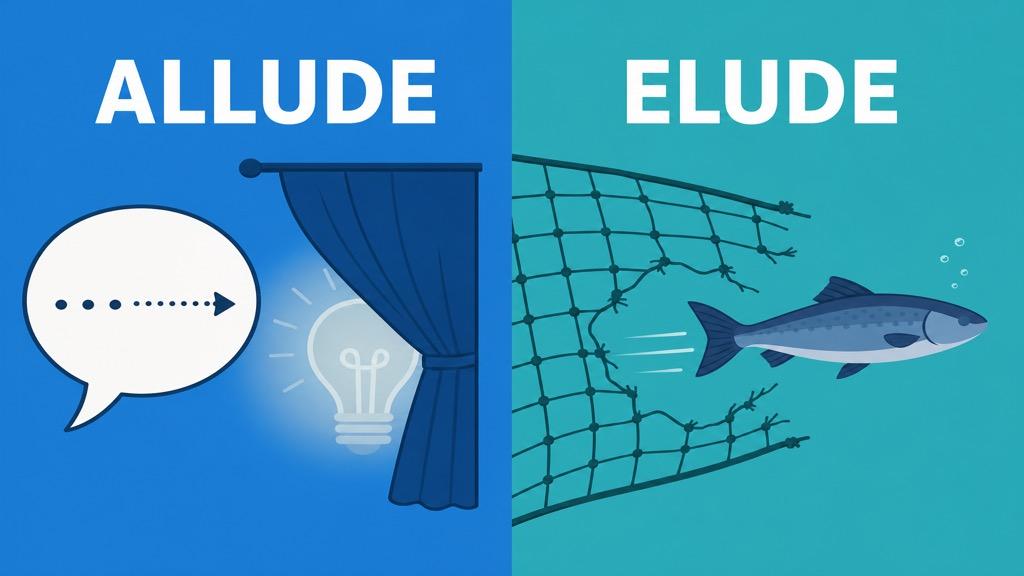
"Allude" means to refer to something indirectly. "Elude" means to escape, evade, or avoid. The two words sound nearly identical, but they share no meaning at all. You allude to a topic when you hint at it without naming it directly, and something eludes you when it slips out of your grasp.
- Allude: "She alluded to the scandal without mentioning any names." (She hinted at it.)
- Elude: "The suspect eluded the police for weeks." (He escaped them.)
The fastest way to keep them straight: "allude" is about words and ideas, while "elude" is about escape and avoidance.
Why Do People Confuse Allude and Elude?
The words are near-homophones, especially in fast speech, and both come from Latin roots ending in "-ludere," meaning "to play." That shared origin makes the spellings look related even though the modern meanings have drifted far apart. The trick is to anchor each word to its everyday context: conversation for "allude," escape for "elude."
How Do You Use Allude Correctly?
"Allude" means to mention something in an indirect or passing way. You point toward a subject without stating it outright.
When Should You Use Allude in a Sentence?
Use "allude" when someone hints at or gestures toward an idea rather than naming it:
- "In his speech, he alluded to past mistakes but never admitted them."
- "The poem alludes to a Greek myth in its final stanza."
- "She alluded to a promotion, though nothing is official yet."
- "The author alludes to her own childhood throughout the novel."
What Preposition Goes With Allude?
"Allude" almost always pairs with to. You allude TO something:
- Correct: "He alluded to the rumors."
- Incorrect: "He alluded the rumors."
If there is no "to" in the sentence, you probably want a different verb, such as "mention" or "reference."
How Do You Use Elude Correctly?
"Elude" means to escape from, evade, or avoid something or someone. It can describe a physical escape or an abstract one, like an idea that you cannot quite grasp.
When Should You Use Elude in a Sentence?
Use "elude" when something gets away or stays out of reach:
- "The fox eluded the hunters by doubling back through the woods."
- "The answer eluded me all night."
- "Success had eluded the team for years."
- "Her name eludes me at the moment."
What Does It Mean When Something Eludes You?
When something "eludes" you, it stays just beyond your reach, whether literally or mentally. A word can elude you when you cannot remember it. A solution can elude a scientist who cannot figure it out. The sense is always one of slipping away.
What Is the Easiest Way to Remember the Difference?
Decide what the sentence is really about. If it involves words, hints, or references, you want "allude." If it involves escaping, evading, or staying out of reach, you want "elude." It helps that "elude," "escape," and "evade" all start with "e."
What About the Noun Forms?
The related nouns also cause confusion:
- Allusion: an indirect reference. "The title is an allusion to a Shakespeare play."
- Elusion: the act of escaping (rare in everyday use). "His elusion of capture became legendary."
Note that "allusion" is also easily confused with "illusion" (a false impression). If you want to dig deeper into indirect references in writing, our guide on allusions explained with examples covers how writers use them.
What Is the Difference Between Allude and Refer?
"Allude" and "refer" both point to something, but the directness differs. When you "refer" to something, you name it openly. When you "allude" to it, you only hint:
- "He referred to the report by name." (Direct, explicit.)
- "He alluded to a report he had read." (Indirect, vague.)
Using "allude" when you mean "refer" can make your writing sound vaguer than you intend, which matters in academic and professional contexts where precision counts.
How Does This Apply in Formal Writing?
In essays and research papers, "allude" signals an intentional, indirect reference, often to a cultural, literary, or historical touchstone. Misusing it can confuse a reader about whether you are hinting or stating a fact. If you are sharpening this kind of precision in longer work, our guide on how to find the right words when writing offers more techniques.
Can Grammar Tools Catch This Mistake?
A standard spell checker will not flag "elude" used in place of "allude" because both are correctly spelled words. The error is semantic. ShyEditor reads the context of your sentence and flags when "elude" appears where "allude to" belongs, or vice versa, so a stray word does not change your meaning.
Quick Reference: Allude vs Elude
| Word | Meaning | Common pairing | Example |
|---|---|---|---|
| Allude | Refer to indirectly | allude to | "She alluded to the news." |
| Elude | Escape or avoid | eludes someone | "The thief eluded the guards." |
Practice Sentences
Test yourself, which word is correct?
- "The novel _____ to events from the author's own life." - alludes (hints at them)
- "The deer _____ the hunters in the thick fog." - eluded (escaped them)
- "I keep trying to recall his name, but it _____ me." - eludes (slips away)
- "In her toast, she _____ to a private joke between them." - alluded (hinted, paired with "to")
- "Victory _____ the team in the final seconds." - eluded (escaped them)
- "The professor _____ to a theory without explaining it fully." - alluded (referenced indirectly)
Write With Clarity
Sound-alike pairs like allude and elude can quietly flip the meaning of a sentence when you grab the wrong one. ShyEditor catches these contextual slips before a reader ever sees them, whether you are weaving subtle allusions into a novel or tightening an academic argument. Try it free: https://www.shyeditor.com