
- Published on
Ensure vs. Insure vs. Assure: What Is the Difference?
- Authors

- Name
- Tony
- @shyeditor
What Is the Difference Between Ensure, Insure, and Assure?
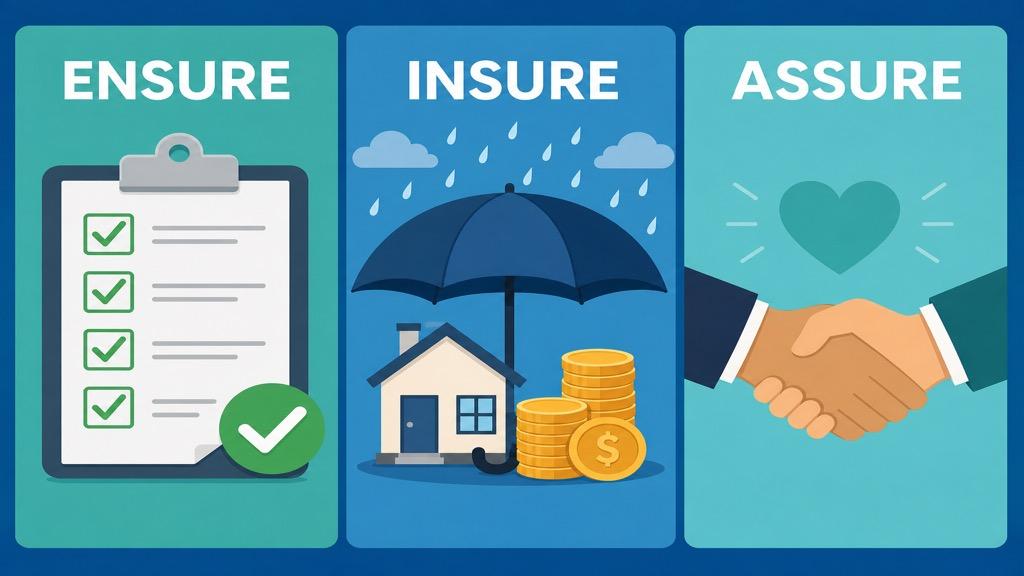
"Ensure" means to make certain something happens. "Insure" means to protect against financial loss with insurance. "Assure" means to remove someone's doubt or worry. All three come from the same Latin root meaning "to make secure," but each has settled into its own specific job in modern English.
- Ensure: "Double-check the locks to ensure the house is secure." (Make certain.)
- Insure: "We insured the car against theft." (Cover with insurance.)
- Assure: "I assure you the package will arrive on time." (Ease a person's doubt.)
The quickest test: if a person is being comforted, use "assure." If money or an insurance policy is involved, use "insure." For everything else about making something certain, use "ensure."
Why Do People Confuse Ensure, Insure, and Assure?
The three words sound almost identical and share a common origin, so the spellings feel interchangeable. The confusion grows because all three relate loosely to the idea of security. The key is to remember that they secure different things: "assure" secures a person's peace of mind, "insure" secures money, and "ensure" secures an outcome.
How Do You Use Assure Correctly?
"Assure" means to tell someone something positively to remove their doubt or worry. It always takes a person (or group of people) as its object.
When Should You Use Assure in a Sentence?
Use "assure" when you are reassuring someone:
- "The doctor assured her that the procedure was safe."
- "I can assure you that we take your concerns seriously."
- "He assured his readers the sequel was coming."
- "The manager assured the team that no one would lose their job."
How Do You Know Assure Is the Right Word?
"Assure" needs a person to receive the reassurance. If you can insert a name or pronoun directly after the verb, "assure" is almost always correct: "I assure you," "she assured the investors," "they assured him." If there is no person being comforted, you probably want "ensure" instead.
How Do You Use Insure Correctly?
"Insure" means to arrange financial protection against loss, damage, or risk through an insurance policy. It is the narrowest of the three words and lives almost entirely in the world of money and risk.
When Should You Use Insure in a Sentence?
Use "insure" when an insurance policy or financial coverage is involved:
- "You should insure your home against flooding."
- "The painting is insured for a million dollars."
- "It costs more to insure a sports car."
- "Freelancers often forget to insure their equipment."
Is Insure Ever Used to Mean Make Certain?
In older texts and some American style guides, "insure" was occasionally used to mean "make certain." Modern usage strongly prefers "ensure" for that meaning and reserves "insure" for insurance contexts. To stay clear and current, keep "insure" tied to policies and premiums.
How Do You Use Ensure Correctly?
"Ensure" means to guarantee or make certain that something happens. It is the all-purpose word for securing an outcome.
When Should You Use Ensure in a Sentence?
Use "ensure" when you are making something certain:
- "Proofreading helps ensure your essay is error-free."
- "Back up your files to ensure you never lose your work."
- "The new rules ensure fair treatment for everyone."
- "Careful planning ensures the project stays on schedule."
How Is Ensure Different From Assure?
"Ensure" acts on a situation or outcome, while "assure" acts on a person. Compare:
- "I want to ensure the report is finished." (Make certain the report is done.)
- "I want to assure the client the report is finished." (Reassure the client.)
If you can replace the verb with "make certain," use "ensure." If you can replace it with "reassure," use "assure."
What Is the Easiest Way to Remember the Difference?
Match each word to what it acts on. "Assure" needs a person on the receiving end, so you assure a friend. "Insure" belongs to the world of insurance policies, so you insure a car. "Ensure" acts on an outcome, so you ensure success.
Does British and American English Treat These Differently?
The distinction holds in both British and American English, though American writing historically allowed "insure" to mean "make certain" more freely. Today, most editors on both sides of the Atlantic keep the three meanings separate. If you write across spelling conventions, our guide on center vs centre covers more US versus UK differences.
How Do You Handle These Words in Formal Writing?
In business, legal, and academic writing, picking the wrong one can change a sentence's meaning or make it sound careless. "We will insure delivery" promises an insurance policy on the shipment, while "We will ensure delivery" promises the package arrives. Those are very different commitments.
Can Grammar Tools Catch This Mistake?
A spell checker will not help here because all three words are spelled correctly. The error is about meaning, not spelling. ShyEditor reads the surrounding context, noticing whether a person, a policy, or an outcome is involved, and flags when "insure," "ensure," or "assure" is the wrong fit. If you are polishing longer work, pair it with our guide on how to edit your own writing.
Quick Reference: Ensure vs Insure vs Assure
| Word | Meaning | What it secures | Example |
|---|---|---|---|
| Ensure | Make certain | An outcome | "Check twice to ensure accuracy." |
| Insure | Cover with insurance | Money or property | "We insured the house." |
| Assure | Remove doubt | A person | "I assure you it works." |
Practice Sentences
Test yourself, which word is correct?
- "Please _____ the door is locked before you leave." - ensure (make certain)
- "You should _____ your jewelry against theft." - insure (insurance coverage)
- "Let me _____ you that everything is fine." - assure (reassuring a person)
- "Good planning _____ the event runs smoothly." - ensures (makes certain)
- "It is expensive to _____ a brand-new car." - insure (insurance)
- "The captain _____ the passengers they were safe." - assured (reassured people)
Write With Clarity
Near-twins like ensure, insure, and assure can shift a sentence's meaning without ever tripping a spell checker. ShyEditor catches these contextual mix-ups before your reader does, whether you are drafting a novel, a cover letter, or a contract. Try it free: https://www.shyeditor.com