
- Published on
Practice vs. Practise: Which Spelling Is Correct?
- Authors

- Name
- Tony
- @shyeditor
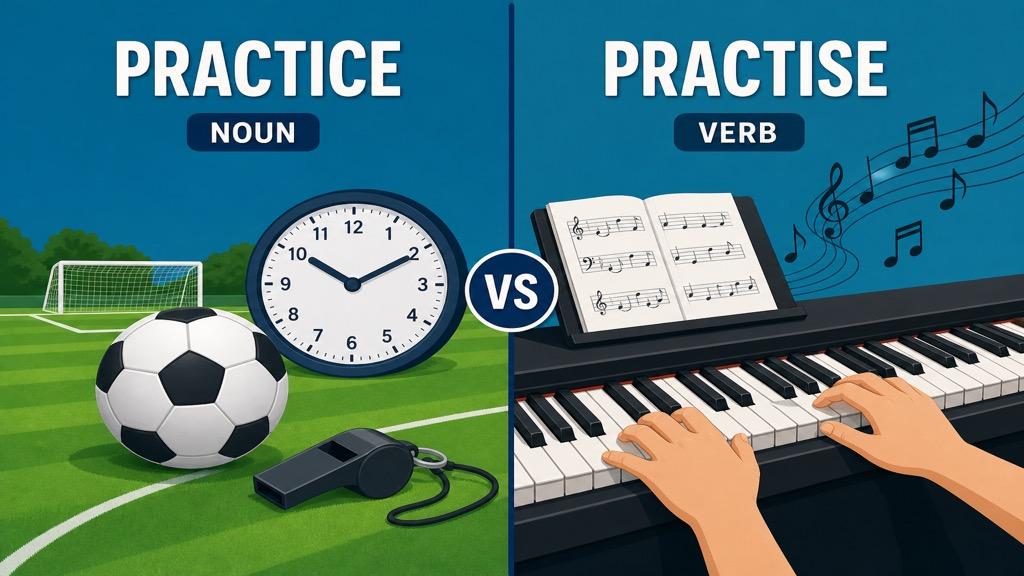
What Is the Difference Between Practice and Practise?
In American English, "practice" is correct for both the noun and the verb. In British English, "practice" is the noun and "practise" is the verb. If you write for an American audience, you never need "practise" at all. If you write for a British, Australian, or Canadian audience, you need to know which form to use.
- Practice (noun): "Piano practice starts at 4 pm."
- Practise (verb, British English): "She practises piano every day."
- Practice (verb, American English): "She practices piano every day."
Why Do Two Spellings Exist?
English has a long history of the same word taking different forms for its noun and verb versions. The practice/practise split follows the same pattern as advice/advise and licence/license in British English: the noun uses a "c" and the verb uses an "s." American English simplified things by dropping the distinction entirely and using "practice" for everything.
How Do You Use Practice as a Noun?
"Practice" as a noun refers to the act of doing something repeatedly to improve, a habitual action, or a professional business. This spelling works in both American and British English when used as a noun.
When Is Practice a Noun in a Sentence?
Use "practice" (with a "c") whenever you can put "the," "a," or "my" in front of it:
- "She has basketball practice after school."
- "The practice of meditation has grown worldwide."
- "He opened a dental practice in the city."
- "That's standard practice in our industry."
What Are Common Noun Phrases With Practice?
Several fixed expressions always use the noun form:
- In practice (as opposed to in theory): "In practice, the system works differently."
- Out of practice: "I'm out of practice with my French."
- Best practice: "Following best practice reduces errors."
- Put into practice: "She put her training into practice."
How Do You Use Practise as a Verb?
In British English, "practise" (with an "s") is the verb form, meaning to do something repeatedly to improve or to work in a profession. In American English, this form doesn't exist. You'd just use "practice" as the verb too.
When Should You Use Practise in British English?
Use "practise" when it's the action word in your sentence. A reliable test: try replacing it with another verb like "do" or "perform." If that substitution works, you need the verb form.
- "You should practise your speech before the meeting." (You should perform your speech.)
- "She practises medicine in London." (She performs medicine.)
- "The band practised for three hours." (The band performed for three hours.)
- "He needs to practise more." (He needs to do more.)
What Happens With -ing and -ed Forms in British English?
The verb "practise" follows regular conjugation rules: practised, practising, practises. All verb forms use the "s" spelling in British English:
- "She was practising her scales."
- "They have practised this routine for weeks."
- "He practises law in Manchester."
In American English, these would be: practicing, practiced, practices, all derived from "practice."
How Can You Tell if Practice or Practise Is Correct?
The fastest method depends on which variant of English you're writing in.
What Is the Advice/Advise Test?
If you're writing in British English and can't tell whether you need the noun or verb, swap in "advice" or "advise." You can hear the difference between those two words: "advice" has a soft "s" sound, and "advise" has a "z" sound.
- "I need more practice/practise." → "I need more advice." (Noun. Use practice.)
- "I should practice/practise more." → "I should advise more." (Verb. Use practise.)
This trick works because practice/practise and advice/advise follow the exact same noun-c, verb-s pattern in British English.
What If You're Writing for an American Audience?
Use "practice" for everything. There's no decision to make. American English does not use "practise" at all, and American spell checkers will flag it as incorrect.
Which Countries Use Practise?
The practice/practise distinction is a regional spelling difference, similar to centre vs. center or cancelled vs. canceled.
Where Is Practise the Standard Verb Spelling?
- United Kingdom: "practise" for verbs, "practice" for nouns
- Australia: follows British convention
- Canada: mostly follows British convention, though American influence is increasing
- New Zealand: follows British convention
- Ireland: follows British convention
Where Is Practice Used for Everything?
- United States: "practice" for both nouns and verbs
- Philippines: follows American convention
- Most international organizations and global publications tend to pick one style and stay consistent
Does Getting Practice vs Practise Wrong Matter?
In American English, you can't get it wrong since there's only one spelling. In British English, mixing them up won't confuse your reader, but it signals carelessness in formal contexts.
How Does This Look in Professional Writing?
- Academic papers (UK): "The study examined current practise in NHS hospitals" should be "practice" (noun). Peer reviewers notice.
- Business reports (UK): "We need to practise better risk management" should be "practice" (noun, part of compound noun phrase). Small error, but it undermines precision.
- Legal documents: The distinction matters more when "practice" refers to a professional business. "The solicitor's practice" (the business) vs "the solicitor practises" (performs the work) carry different legal weight.
In less formal writing, blog posts, emails, social media, most readers won't flag it. But why get it wrong when the rule is straightforward?
Can Writing Tools Catch This Mistake?
Standard spell checkers accept both spellings as valid words, so they won't help you choose the right one. You need a tool that understands whether you're using a noun or a verb. ShyEditor analyzes the grammatical role of each word in your sentence and flags noun/verb mismatches like this one automatically, whether you're writing in American or British English.
Quick Reference: Practice vs Practise
| Spelling | Role | Region | Example |
|---|---|---|---|
| Practice | Noun | US + UK | "Basketball practice is at 5." |
| Practice | Verb | US only | "I practice every day." |
| Practise | Verb | UK, AU, CA | "I practise every day." |
Practice Sentences
Test yourself, which is correct in British English?
- "She needs more _____ before the exam." - practice (noun, you can say "more practice")
- "Do you _____ yoga regularly?" - practise (verb, you can say "do yoga")
- "His medical _____ is on High Street." - practice (noun, a professional business)
- "The team _____ every Tuesday." - practises (verb, the team does something)
- "It takes years of _____ to master an instrument." - practice (noun, preceded by "of")
- "She _____ what she preaches." - practises (verb, she does what she preaches)
If you're writing in American English, the answer to all six is "practice."
Write With Confidence in Any Dialect
Regional spelling differences like practice/practise are easy to overlook, especially if you write for audiences in multiple countries. ShyEditor catches these contextual spelling issues and adapts to your chosen English dialect, so whether you're drafting a novel or a business proposal, your spelling stays consistent. Try it free: https://www.shyeditor.com