
- Published on
Farther vs. Further: Which One Should You Use?
- Authors

- Name
- Tony
- @shyeditor
What Is the Difference Between Farther and Further?
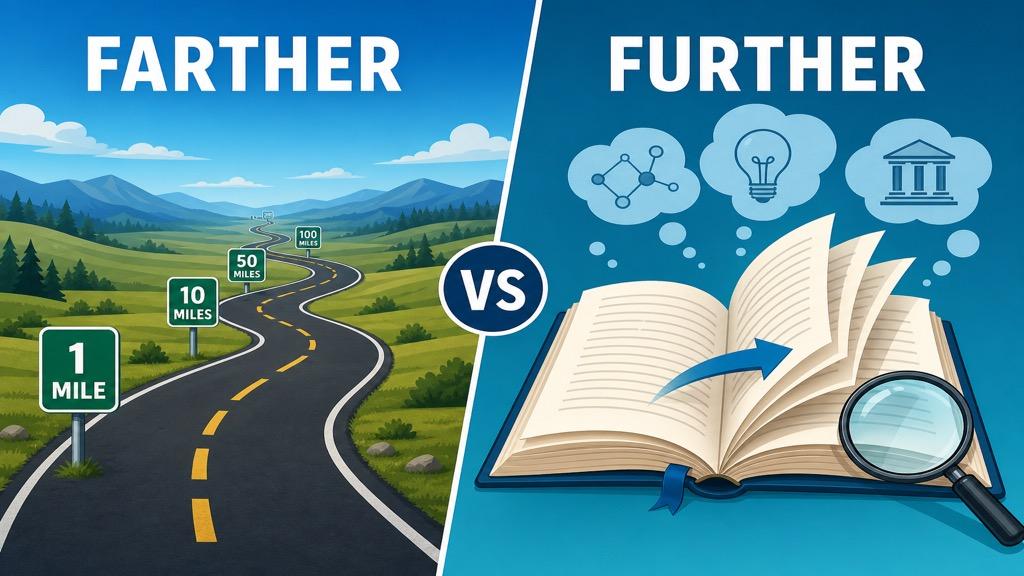
"Farther" refers to physical, measurable distance. "Further" refers to figurative extent, degree, or additional amount. If you can measure the distance in miles, meters, or steps, use "farther." If you're talking about something abstract like progress, depth, or continuation, use "further."
- Farther: "The airport is farther than I thought." (Physical distance.)
- Further: "Let's discuss this further." (To a greater degree.)
Why Is This Distinction So Confusing?
Both words come from the same Old English root and were used interchangeably for centuries. The distinction between physical and figurative distance only became a standard guideline in the 20th century. Even today, many style guides acknowledge that "further" is widely accepted in both contexts, especially in British English. But in careful American English writing, the distinction holds, and observing it signals precision.
How Do You Use Farther Correctly?
"Farther" is the comparative form of "far" when referring to physical distance. If you could answer the question "how far?" with a number, "farther" is the right word.
When Should You Use Farther in a Sentence?
Use "farther" whenever the sentence involves literal, measurable distance:
- "We hiked farther up the trail than yesterday."
- "The library is farther from my house than the bookstore."
- "How much farther do we have to drive?"
- "She threw the ball farther than anyone else on the team."
In every case, you're talking about spatial distance that could, at least in theory, be measured.
Can Farther Be Used as an Adjective?
Yes. "Farther" works as both a comparative adjective and an adverb, as long as physical distance is involved:
- As an adjective: "The farther shore was barely visible." (The shore that is more distant.)
- As an adverb: "We need to walk farther." (To a greater distance.)
How Do You Use Further Correctly?
"Further" means to a greater extent, additional, or more. It covers everything that isn't physical distance: abstract progress, additional actions, deeper exploration of a topic. It also works as a verb meaning "to advance" something.
When Should You Use Further in a Sentence?
Use "further" when the distance is metaphorical or the meaning is "additional" or "more":
- "We need to investigate this further." (To a greater extent.)
- "No further questions." (No additional questions.)
- "She decided not to pursue the matter any further." (Any more.)
- "Further reading is available in the appendix." (Additional reading.)
Can Further Be Used as a Verb?
Yes, and "farther" cannot. "Further" as a verb means to advance or promote something:
- "She worked hard to further her career."
- "The grant will further our research."
- "He took the course to further his understanding of economics."
This is an easy way to remember the distinction: if you're using the word as a verb, it's always "further."
What Is the Easiest Way to Choose Between Farther and Further?
Ask yourself one question: can I measure this distance with a ruler, odometer, or GPS?
What Is the Physical Distance Test?
- If yes (physical, measurable distance) → farther. "The grocery store is farther away."
- If no (abstract, figurative, or "additional") → further. "Let me explain further."
- If you're using it as a verb → always further. "She wants to further her education."
What About Cases Where Both Could Work?
Some sentences genuinely fall in a gray area:
- "We're not going any farther/further with this project."
If the "distance" is ambiguous, either physical or figurative, most style guides accept both. When in doubt, default to "further," which has the broader range. The only situation where "further" is clearly wrong is a sentence that's unambiguously about physical distance, like "The gas station is further/farther down the highway." There, "farther" is the precise choice.
How Do Farther and Further Work in British vs American English?
The distinction is primarily an American English guideline. British English treats them differently.
Does British English Distinguish Between Farther and Further?
Not strictly. In British English, "further" is commonly used for both physical and figurative distance, and "farther" appears much less often. Most British style guides accept "further" universally. You won't be marked wrong for using "farther" in British English when physical distance is meant, but "further" is the default. This is similar to other regional spelling and usage differences that vary between American and British conventions.
What Do Major Style Guides Say?
- AP Stylebook (American): Use "farther" for physical distance, "further" for degree or extent.
- Chicago Manual of Style: Same recommendation as AP.
- Oxford Style Guide (British): Accepts "further" in all contexts, notes "farther" as an alternative for physical distance.
- Fowler's Modern English Usage: Acknowledges the distinction as a useful one but not a hard rule.
Does Getting Farther vs Further Wrong Matter?
Using "further" where "farther" would be more precise is rarely a serious error, even the strictest grammarians won't call it incorrect. Going the other direction, using "farther" for figurative distance, sounds noticeably wrong.
Which Mistake Is Worse?
- "Let's discuss this farther." - Sounds odd. "Farther" with abstract concepts jars the reader.
- "The lake is further away than I expected." - Technically imprecise in American English, but widely accepted. Most readers won't notice.
The practical takeaway: never use "farther" for figurative distance. Using "further" for physical distance is debatable but defensible.
How Does This Affect Professional Writing?
In contexts where precision matters, academic papers, published articles, and formal reports, following the farther/further distinction shows attention to detail. If you're working on polishing your formal writing, our self-editing checklist covers this and other commonly overlooked word-choice issues.
ShyEditor flags these word-choice issues in context, distinguishing between physical and figurative usage so you don't have to think about it.
Quick Reference: Farther vs Further
| Word | Use for | Test | Example |
|---|---|---|---|
| Farther | Physical distance | Can you measure it? | "The park is farther east." |
| Further | Degree, extent, additional | Is it abstract or figurative? | "Let's look into this further." |
| Further | As a verb (to advance) | Is it an action word? | "She wants to further her goals." |
Practice Sentences
Test yourself, which is correct?
- "The hotel is _____ from the beach than we expected." - farther (measurable physical distance)
- "I have nothing _____ to add." - further (nothing additional)
- "We drove _____ north before stopping for gas." - farther (physical distance on a road)
- "This report needs _____ review." - further (additional review)
- "The new policy will _____ our sustainability goals." - further (verb meaning to advance)
- "How much _____ is it to the next rest stop?" - farther (physical distance you could measure)
Write With Precision
Word-choice distinctions like farther vs further are subtle, and that's exactly where careful writers separate themselves. ShyEditor catches these nuanced usage issues as you write, whether you're drafting a novel or a research paper. Try it free: https://www.shyeditor.com