
- Published on
Peek vs. Peak vs. Pique: What Is the Difference?
- Authors

- Name
- Tony
- @shyeditor
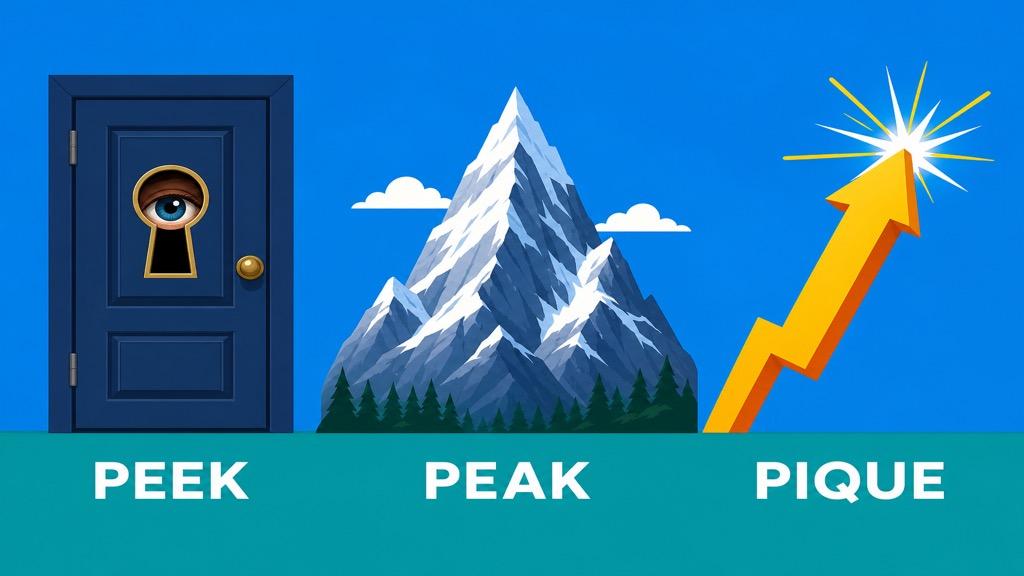
What Is the Difference Between Peek, Peak, and Pique?
"Peek" means a quick or secret look. "Peak" means the highest point of something. "Pique" means to arouse interest or, as a feeling, a fit of irritation. All three are pronounced the same way, but each carries a separate meaning and is almost never interchangeable.
- Peek: "She took a quick peek behind the curtain." (A brief look.)
- Peak: "We reached the peak of the mountain." (The top.)
- Pique: "The trailer was made to pique your curiosity." (To stir up.)
The simple rule: "peek" is for looking (note the two e's, like a pair of eyes), "peak" is for tops, and "pique" is the fancy French one for interest or irritation.
Why Do People Confuse Peek, Peak, and Pique?
All three are homophones, pronounced identically, and two of them ("peek" and "peak") differ by only one vowel. "Pique" looks foreign and unfamiliar, so writers often reach for "peak" or "peek" instead, producing common errors like "peak my interest" or "peaked my curiosity." The fix is to learn which spelling matches which meaning and lean on a quick memory cue for each.
How Do You Use Peek Correctly?
"Peek" means to look quickly, secretly, or through a narrow opening. It works as both a verb and a noun and always involves looking.
When Should You Use Peek in a Sentence?
Use "peek" whenever something is being glanced at, especially briefly or slyly:
- "Don't peek at your presents."
- "He took a peek at the answer key."
- "The sun peeked over the horizon."
- "Can I have a peek at your notes?"
A reliable cue: "peek" has two e's, and so does "see." If the word involves your eyes, you want "peek."
What Is the Correct Spelling, Sneak Peek or Sneak Peak?
It is "sneak peek," because a sneak peek is a quick, early look at something. "Sneak peak" is one of the most common spelling errors in English, but a mountaintop has nothing to do with previewing a movie or a product, so the looking spelling is the right one.
How Do You Use Peak Correctly?
"Peak" means the highest point, top, or summit of something, whether a literal mountain or a figurative high point. It can be a noun, a verb, or an adjective, but it always relates to a maximum or a top.
When Does Peak Mean a Summit or Top?
Use "peak" for the literal or figurative top of something:
- "Snow covered the mountain peak."
- "Her career reached its peak in her thirties."
- "Ticket sales hit a peak in December."
- "The athlete trained to stay in peak condition."
When Is Peak Used as a Verb?
"Peak" as a verb means to reach a maximum and then level off or decline:
- "Interest in the show peaked after the finale."
- "Prices peaked last summer."
If you mean "reached the top," you want "peaked," not "piqued."
How Do You Use Pique Correctly?
"Pique" means to stir up or arouse, most often interest or curiosity, and as a noun it names a fit of irritation or wounded pride. It comes from French and is the spelling most writers forget.
When Does Pique Mean to Stir Up Interest?
Use "pique" when something awakens curiosity or interest:
- "The mystery piqued my interest."
- "A good opening line should pique the reader's curiosity."
- "Her question piqued his attention."
The correct phrase is "pique my interest," not "peak my interest" or "peek my interest." Something is sharpening or provoking your curiosity, not climbing to a summit.
When Does Pique Mean Irritation?
As a noun, "pique" means a feeling of irritation or resentment, usually from hurt pride:
- "She left the room in a fit of pique."
- "He slammed the door in a moment of pique."
This sense connects to the original French meaning of "to prick" or "to sting," which is also why "pique" can mean to provoke.
What Is the Easiest Way to Remember the Difference?
Match the spelling to the meaning with a cue for each: "peek" has two e's like a pair of eyes, "peak" has an A that looks like a pointed mountaintop, and "pique" is the unusual French spelling reserved for interest and irritation.
Is There a Trick for Pique My Interest?
Yes. Picture "pique" as a tiny pinprick that pokes your curiosity awake. The word literally comes from a French verb meaning to prick or sting, so when an idea pokes at your interest, it "piques" it. If you catch yourself writing "peak my interest," remember that no mountain is involved, only a small jab of curiosity.
How Do You Handle These Words in Formal Writing?
In essays, marketing copy, and fiction, mixing these up is a visible error that can undercut your credibility. "The book peaked my interest" tells an attentive reader that you reached for the wrong homophone, while "the book piqued my interest" reads as polished. Hooking a reader's curiosity is central to strong openings, and our guide to how to start an essay covers how to do that well.
Can Grammar Tools Catch This Mistake?
A standard spell checker accepts all three spellings as valid words, so it will not flag "peak my interest" or "sneak peak." The error is contextual. ShyEditor reads the meaning of your sentence and flags when "peak" or "peek" appears where you mean to arouse interest, or when "peek" shows up where you mean a summit. If you are crafting opening lines meant to hook a reader, pair this with our creative writing tips.
Quick Reference: Peek vs Peak vs Pique
| Word | Meaning | Example |
|---|---|---|
| Peek | A quick or secret look | "Take a peek." |
| Peak | The top or highest point | "Mountain peak." |
| Pique (verb) | To stir up interest | "Pique my curiosity." |
| Pique (noun) | A fit of irritation | "A fit of pique." |
Practice Sentences
Test yourself, which word is correct?
- "Climbers spent the night near the snowy _____." - peak (summit)
- "The teaser was designed to _____ our interest." - pique (to stir up)
- "He could not resist a quick _____ inside the box." - peek (a look)
- "She stormed off in a fit of _____." - pique (irritation)
- "Subscriber numbers _____ over the holidays." - peaked (reached a maximum)
- "Don't _____ at the last page of the novel." - peek (look)
Write With Confidence
Homophones like peek, peak, and pique sound identical but carry completely different meanings. ShyEditor catches these contextual slips before they reach the page, whether you are writing a novel, an essay, or marketing copy. Try it free: https://www.shyeditor.com