
- Published on
Dessert vs. Desert: What Is the Difference?
- Authors

- Name
- Tony
- @shyeditor
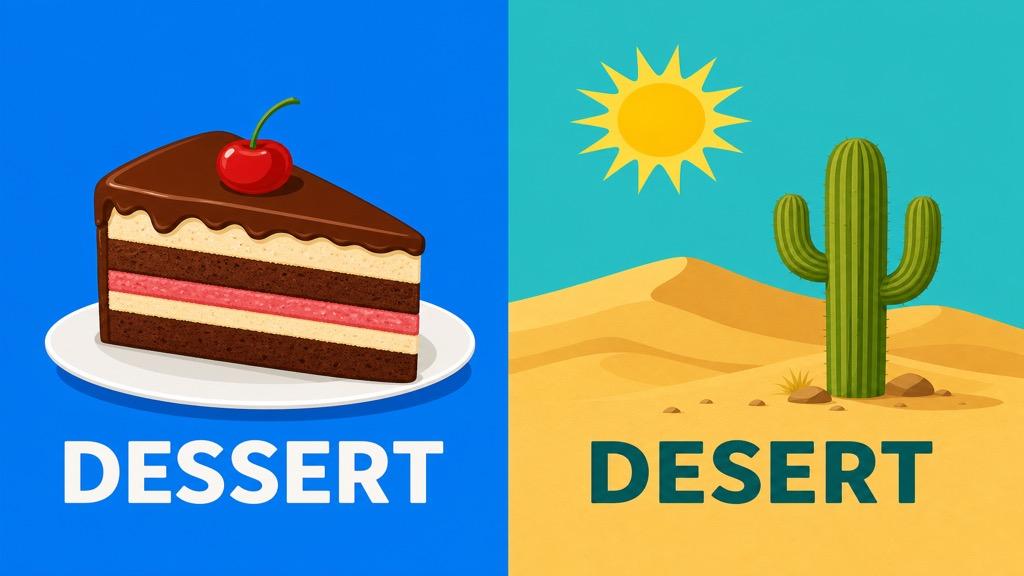
What Is the Difference Between Dessert and Desert?
"Dessert" with two s's is the sweet course at the end of a meal. "Desert" with one s is a dry, sandy region, or, as a verb, it means to abandon someone or something. The two words are spelled almost identically and differ by a single letter, but they point to completely different things.
- Dessert: "We had cheesecake for dessert." (The sweet final course.)
- Desert (noun): "Camels cross the desert with ease." (A dry, arid region.)
- Desert (verb): "He would never desert his friends." (To abandon.)
The simple rule: the sweet one has two s's because you always want a second helping.
Why Do People Confuse Dessert and Desert?
The words look nearly identical, separated by just one letter, and two of the three meanings are even pronounced differently from the food. "Dessert" (the food) and "desert" (the verb meaning to abandon) sound the same, stress on the second syllable, while "desert" (the sandy place) stresses the first syllable. That overlap in sound and spelling makes the pair easy to mix up. The fix is a memory trick built on the spelling itself.
How Do You Use Dessert Correctly?
"Dessert" always refers to the sweet course served at the end of a meal: cake, pie, ice cream, pudding, and the like. It is only ever a noun and always spelled with two s's.
When Should You Use Dessert in a Sentence?
Use "dessert" whenever you mean something sweet eaten after the main meal:
- "The restaurant is famous for its chocolate dessert."
- "Save room for dessert."
- "She ordered the dessert menu without looking at anything else."
- "A scoop of sorbet makes a light dessert."
If you can replace the word with "the sweet course," you want "dessert" with two s's.
How Do You Use Desert Correctly?
"Desert" has two distinct uses: as a noun it names a dry, sandy, arid region, and as a verb it means to abandon or leave behind. Both are spelled with a single s, even though the verb sounds exactly like "dessert."
When Does Desert Mean a Dry Region?
Use "desert" (stress on the first syllable, DEZ-ert) for an arid landscape:
- "The Sahara is the largest hot desert on Earth."
- "Little rain falls in the desert."
- "They drove for hours through empty desert."
When Does Desert Mean to Abandon?
Use "desert" (stress on the second syllable, dih-ZERT) when someone leaves or abandons something:
- "The soldiers refused to desert their post."
- "Do not desert me now."
- "The town was deserted after the factory closed."
This verb sense is why a quiet, empty place is described as "deserted," meaning everyone has left it.
What About the Phrase "Just Deserts"?
The phrase meaning "the punishment or reward someone deserves" is "just deserts," spelled with one s, even though it sounds like the dessert you eat. This older meaning of "desert" comes from the same root as "deserve." So "he got his just deserts" is correct, and "just desserts" is a common error (though it is sometimes used as a deliberate pun on a menu).
What Is the Easiest Way to Remember the Difference?
Remember that "dessert" has two s's because you always want a second serving of something sweet. The single-s "desert" is the one you want to get out of quickly, so it has fewer letters.
Is There a Trick Based on the Words Themselves?
Yes. "Dessert" contains the word "sweet" in spirit, and the double s can stand for "so sweet." Another reliable cue: "strawberry shortcake" gives you two s sounds, matching the two s's in dessert. For the sandy "desert," picture how the single s sits alone in the middle, just as a lone traveler stands alone in a vast, empty landscape.
How Do You Handle These Words in Formal Writing?
In recipes, restaurant reviews, travel writing, and fiction, the distinction matters because a swapped letter changes the meaning entirely. "They wandered into the dessert" accidentally sends your characters into a plate of cake rather than across the sand. In creative writing especially, this kind of slip can pull a reader out of an otherwise vivid scene.
Can Grammar Tools Catch This Mistake?
A standard spell checker treats both spellings as valid words, so it will not flag "dessert" when you meant the sandy "desert." The error is contextual. ShyEditor reads the meaning of your sentence and flags when "dessert" appears where you describe an arid landscape, or when "desert" shows up where you clearly mean something sweet. If you are writing a novel set in a harsh, sun-baked land, our guide to building fictional worlds can help you make the setting feel real.
Quick Reference: Dessert vs Desert
| Word | Meaning | Example |
|---|---|---|
| Dessert | The sweet final course | "Pie for dessert." |
| Desert (noun) | A dry, sandy region | "Crossing the desert." |
| Desert (verb) | To abandon | "Don't desert us." |
| Deserts | What one deserves | "His just deserts." |
Practice Sentences
Test yourself, which word is correct?
- "After dinner we shared a slice of _____." - dessert (the sweet course)
- "Cacti are well adapted to life in the _____." - desert (dry region)
- "A loyal captain would never _____ his crew." - desert (to abandon)
- "The streets were _____ at midnight." - deserted (empty, abandoned)
- "The villain finally got his just _____." - deserts (what he deserved)
Write With Confidence
Homophones like dessert and desert differ by a single letter but can drop your reader into the wrong scene entirely. ShyEditor catches these contextual slips before they reach the page, whether you are writing a novel, a travel essay, or a recipe. Try it free: https://www.shyeditor.com